
Herpes simplex virus (HSV) functions as one of the most common viral disorders globally. The two strains HSV-1 and HSV-2 exhibit repetitive episodes while causing oral herpes in the mouth and genital herpes in the genitals. The accurate diagnosis of herpes infections proves essential to control the disease course and prevent disease spread. PCR test represents the current advanced diagnostic test approach that medical facilities use today. A report published by the World Health Organization in December 2024 estimates that globally 64% of people under the age of 50 suffer from HSV-1 and 13% from HSV-2 under the age of 15–49. This article highlights the preventive measures and diagnostic techniques to overcome the herpes virus.
Understanding herpes simplex virus (HSV)
The fundamental knowledge of herpes simplex virus (HSV) combined with its clinical implications should be established before starting the PCR herpes test.
HSV exists in two sorts:
- HSV-1: Essentially connected with oral herpes, causing mouth blisters and fever blisters. It can also lead to genital herpes.
- HSV-2: Prevalently connected to genital herpes yet can likewise bring about oral diseases.
HSV diseases are long-lasting, with the infection enduring in a dormant state inside nerve cells. Occasional reactivation can prompt indicative outbreaks or asymptomatic viral shedding, the two of which can add to transmission.
Role of diagnostic tests for HSV
Precise analysis of HSV is fundamental in light of multiple factors:
- Symptomatic management: Medical services suppliers can prescribe antiviral medications to patients diagnosed with HSV so they can control their symptoms and decrease the frequency of outbreaks.
- Reducing transmission: People who receive a diagnosis can take preventive actions such as condom use and antiviral prophylaxis to prevent transmission of the infection.
- Differential diagnosis: HSV imparts side effects to different diseases and conditions. Testing guarantees exact differentiation, prompting legitimate treatment.
Conventional diagnostic techniques incorporate viral culture, serological tests, and antigen discovery. Notwithstanding, these strategies have limitations, especially as far as awareness and the capacity to identify inactive or asymptomatic contaminations. This is where PCR testing arises as a unique advantage.
PCR principle
Polymerase chain reaction (PCR) is a molecular diagnostic method intended to intensify and identify specific hereditary material of microbes and viruses. Created by Kary Mullis in 1983, PCR has changed analytic medication by offering unparalleled sensitivity and explicitness.
The interaction includes three primary steps.
Denaturation
Heating double-stranded DNA results in the separation into two single-stranded segments.
Annealing
Short RNA nucleotide sequences named primers serve to bind at the 3’ end of both DNA strands where they are complementary to the target DNA.
Extension
A DNA polymerase enzyme polymerizes the primers, duplicating new DNA strands corresponding to the target strand.
These steps are repeated in cycles, dramatically amplifying the target DNA, and making even trace amounts perceptible.
Working on PCR herpes test
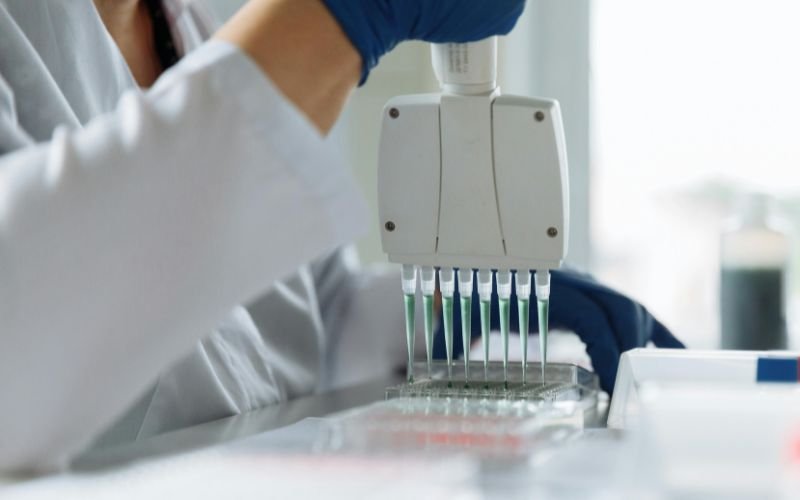
The PCR herpes test recognizes HSV DNA in a patient sample, commonly extracted from sores, blood, cerebrospinal liquid (CSF), or other body fluids. Here is a procedure outline:
Sample collection
A swab is utilized to gather cells or fluid from an active blister. For suspected fundamental or neurological HSV diseases, blood or CSF might be utilized.
DNA extraction
The sample goes through a preparation cycle to segregate DNA.
PCR amplification
PCR amplification utilizes designed primers to magnify DNA of both HSV-1 and HSV-2.
Detection
The testing procedure includes detecting amplified DNA with fluorescent markers or gel electrophoresis which confirms the presence of HSV DNA.
Advantages of PCR herpes test
- High sensitivity: The high sensitivity of PCR enables detection of minimal viral DNA quantities which makes the test most suitable for diseases with low viral levels or asymptomatic conditions.
- High specificity: The design characteristics of this test ensure high specificity by targeting HSV DNA which reduces incorrect results from cross-reactivity of different microbial infections.
- Rapid results: PCR enables quick medical results delivery which speeds up both examination and treatment initiation processes.
- Differentiation of HSV types: PCR provides the identification of both HSV-1 and HSV-2 viruses to help shape patient care strategies and counseling approaches.
- Broad applicability: The diagnostic power of the test extends to multiple testing materials such as injuries, blood specimens, and cerebrospinal fluid which enhances its capability for diagnosing localized and systemic infections.
Applications of PCR herpes test
- Genital herpes diagnosis: The PCR herpes test functions well to diagnose genital herpes, particularly during healing sore periods when viral culture might become unsuccessful.
- Neonatal herpes: Newborn herpes presents as a dangerous infant condition having high death rates among affected infants. PCR testing of blood or CSF is vital for quick and precise determination, empowering life-saving antiviral treatment.
- HSV encephalitis: HSV is a main source of viral encephalitis, a deadly contamination. PCR testing of CSF is the highest quality level for diagnosing HSV encephalitis, as it offers a quick and solid location of the infection.
- Asymptomatic shedding: PCR is sensitive enough to distinguish HSV in asymptomatic people, assisting with recognizing carriers that may transfer the infection.
- Research and epidemiology: PCR works by concentrating on HSV predominance, transmission elements, and treatment viability, adding to a better understanding of the infection and its control.
Limitations of PCR herpes test
Regardless of its many benefits, the PCR herpes test has a few limitations.
- Cost: PCR tests are more costly than traditional techniques, which might restrict accessibility in asset-compelled settings.
- Technical expertise: Performing PCR requires particular gear and prepared staff, making it less plausible in all medical care settings.
- Sample quality: The accuracy of PCR relies upon the nature of the sample gathered. Inappropriate assortment, handling, or capacity can prompt negatives in the results.
- Limited utility for latent infections: While PCR recognizes dynamic diseases actually, it can’t distinguish dormant HSV living in nerve cells.
- Overdiagnosis risk: Because of its high responsiveness, PCR might recognize clinically unimportant viral DNA, prompting potential overdiagnosis and superfluous treatment.
Comparison with other diagnostic methods
| Diagnostic method | Advantages | Limitations |
| Viral culture | High specificity; can confirm active infection | Low sensitivity; time-consuming |
| Serological tests | Detects past exposure; simple and widely available | Cannot differentiate recent vs. past infections |
| Antigen detection | Quick and easy | Lower sensitivity and specificity than PCR |
| PCR | High sensitivity and specificity; rapid results | Costly; requires technical expertise |
When is a PCR herpes test recommended?
Medical services suppliers might suggest the PCR herpes test in the following situations:
- Active Lesions: When a patient presents with oral or genital sores, particularly in the beginning phases when the viral level is high.
- Pregnancy: To evaluate the risk of neonatal herpes if a pregnant individual has HSV side effects or a history of the disease.
- Neurological Symptoms: In instances of suspected HSV encephalitis or meningitis.
- Unclear Diagnosis: When other diagnostic techniques yield uncertain outcomes.
Preparation for the test
Preparation for a PCR herpes test relies upon the sample type.
- Lesion swabs: Patients should try not to apply creams or lotions to the injury before testing.
- Blood or CSF samples: These require no particular preparation except standard methods for test sample collection.
Patients ought to consult their medical care supplier about any drugs or therapies they are going through that could influence test results.
Interpreting PCR herpes test results
- Positive result: Demonstrates the presence of HSV DNA, affirming a functioning disease.
- Negative result: Recommends the absence of perceptible HSV DNA however does not completely preclude HSV, particularly on the off chance that the sample was deficient or gathered late.
Future directions and innovations
Continuous advancements are expected to make PCR testing more available and financially savvy. Arising innovations like PCR instruments and mechanized testing frameworks extend the accessibility of PCR herpes tests to essential consideration settings and resource-restricted areas. Research published in 2023 in Diagnostic Molecular and Infectious Disease suggests that multiplex PCR appears to have a better diagnostic evaluation and is more cost-effective with limited clinical materials used to help in the detection of herpes virus and Treponema pallidum.
Diagnostic tool for herpes infections
The PCR herpes test is a powerful diagnostic device that has changed the direction and the executives of HSV diseases. With its unmatched awareness and specificity, it is priceless for diagnosing dynamic HSV diseases, directing treatment, and preventing transmission. While its limits should be considered, the advantages of PCR testing far offset its downsides, making it a foundation of modern virology diagnostics. As innovation progresses, PCR testing is ready to turn out to be significantly more necessary to worldwide efforts in managing herpes simplex infections.
“On the off chance that you suspect an HSV infection, talk with a medical specialist about HSV testing, a reliable PCR test for the most accurate herpes diagnosis.”